How I Work with AI
Overview
I use AI across my whole design process, from research all the way to production. Not as a shortcut, but as a collaborator I actually direct.
Honestly, the difference isn't the tools everyone has access to. It's the systems I build around them. The core one is SDD — Spec-Driven Design. I borrowed the idea from the spec-driven development practice engineers use and rebuilt it for design: it writes PRDs from my research and critiques them before I even read them. On top of that I've built my own guardrails and skills for shipping production frontend. Here's how it all fits together.
Honestly, the difference isn't the tools everyone has access to. It's the systems I build around them. The core one is SDD — Spec-Driven Design. I borrowed the idea from the spec-driven development practice engineers use and rebuilt it for design: it writes PRDs from my research and critiques them before I even read them. On top of that I've built my own guardrails and skills for shipping production frontend. Here's how it all fits together.
SERVICES
AI-assisted research
Context & spec authoring
PRD definition
Rapid prototyping
User validation
Design-to-dev handoff
Production frontend
AI tooling & workflow
MY ROLE
Product Designer · Design Engineer (AI-native)
YEAR
2025 – Present
The process
It's the standard design process. What's different is that AI is in the loop at every step, with my own systems running underneath. Here's what changes at each one:
Discover
AI captures the whole interview in Notion so I can actually stay present. My job is deciding which signals matter.
Synthesize
I feed my notes into SDD, and every PRD I write adds to its knowledge, so its context gets richer and sharper with each project.
Define
SDD drafts the PRD and runs it through a panel of critics before it even reaches me. Then I push back and iterate.
Prototype
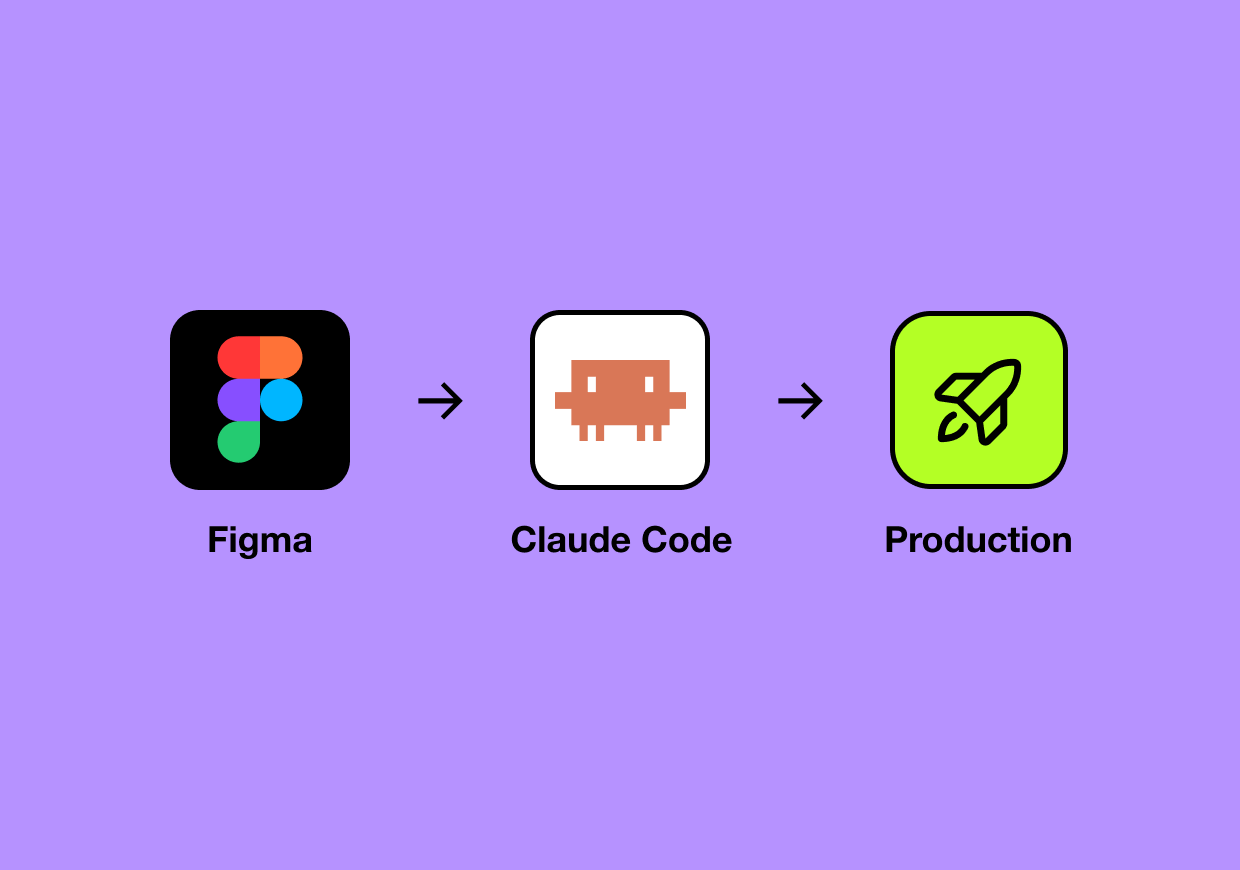
I build something clickable in Claude Code or a quick Artifact, and I scale the fidelity to the question I'm trying to answer.
Validate
Real users, fast loops. Since prototyping is quick, I can iterate way more in less time.
Handoff
Engineering gets the final PRD plus a working prototype, so there's basically nothing left to guess.
SDD
Spec-Driven Design — the spec system I built
SDD is the engine my whole process runs on. I built it so a single designer can produce specs at the level a whole team usually needs, and now other people on my team use it too, not just me. So far it has written 45 PRDs.
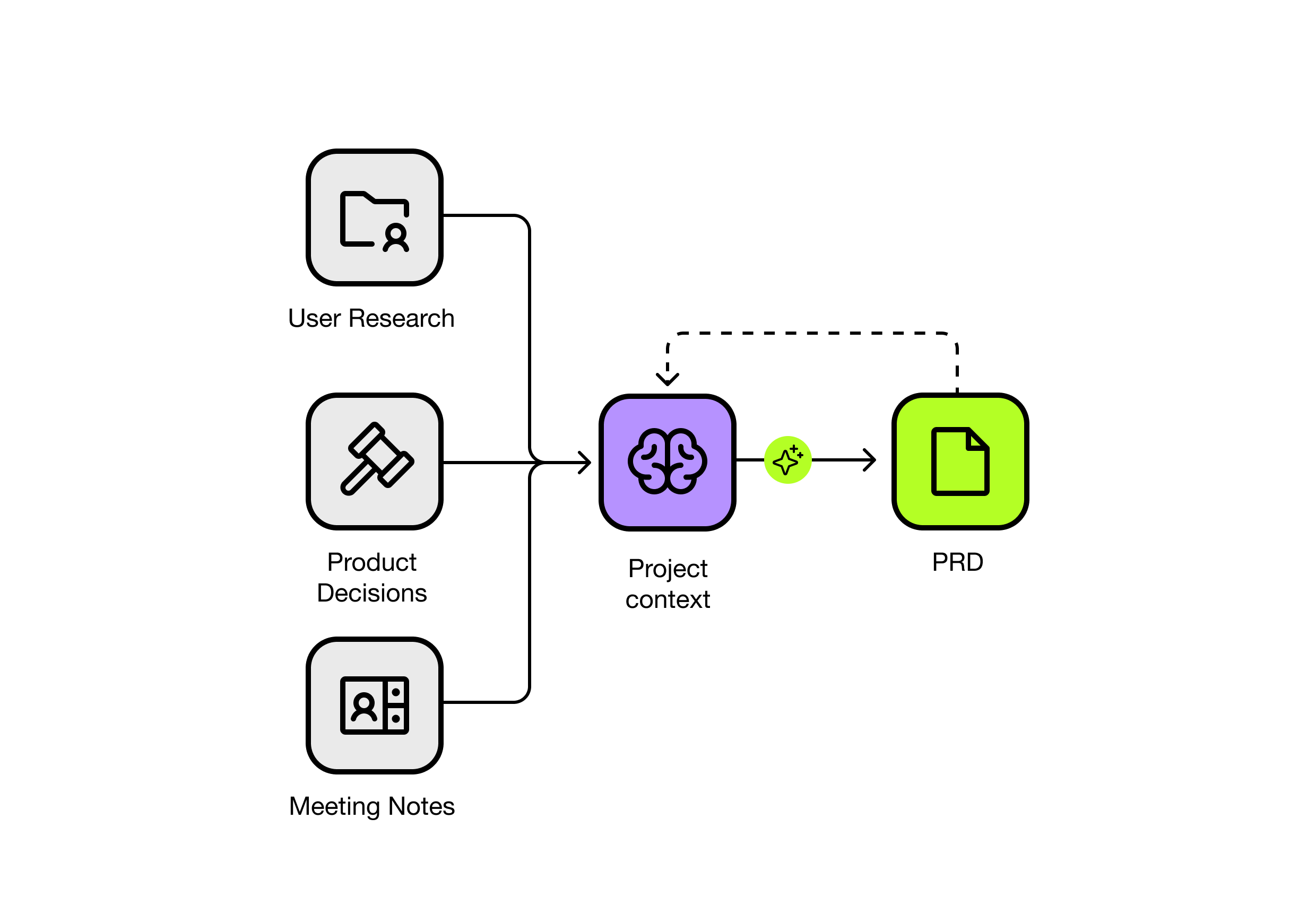
It starts from the context I feed it after research and turns it into a PRD: the why, the what, the edge cases, and how we'll measure success. But here's the part I like. Before I read a single word, it runs the draft through a panel of specialized critics: an engineering pass, a UX pass, a product-sense pass built on Shreyas Doshi's frameworks, and a first-principles pass that's biased toward deleting things. Each one grades the spec against its own rubric, so the weak spots show up before I waste time on them.
Two things make it compound. First, scope-based templates, so a small tweak and a big new initiative each get the right depth of spec instead of the same bloated one. Second, a knowledge base that grows with every project: each PRD I write feeds back in, so the next spec starts smarter and faster. I really believe a tool isn't worth much unless it learns from its own use, so I built SDD to get better the more I lean on it.
It starts from the context I feed it after research and turns it into a PRD: the why, the what, the edge cases, and how we'll measure success. But here's the part I like. Before I read a single word, it runs the draft through a panel of specialized critics: an engineering pass, a UX pass, a product-sense pass built on Shreyas Doshi's frameworks, and a first-principles pass that's biased toward deleting things. Each one grades the spec against its own rubric, so the weak spots show up before I waste time on them.
Two things make it compound. First, scope-based templates, so a small tweak and a big new initiative each get the right depth of spec instead of the same bloated one. Second, a knowledge base that grows with every project: each PRD I write feeds back in, so the next spec starts smarter and faster. I really believe a tool isn't worth much unless it learns from its own use, so I built SDD to get better the more I lean on it.
Skills I built
Tooling that keeps my frontend high-quality
Designing is only half of what I do. I also ship production frontend, so I built the tooling that keeps that work at a high bar.
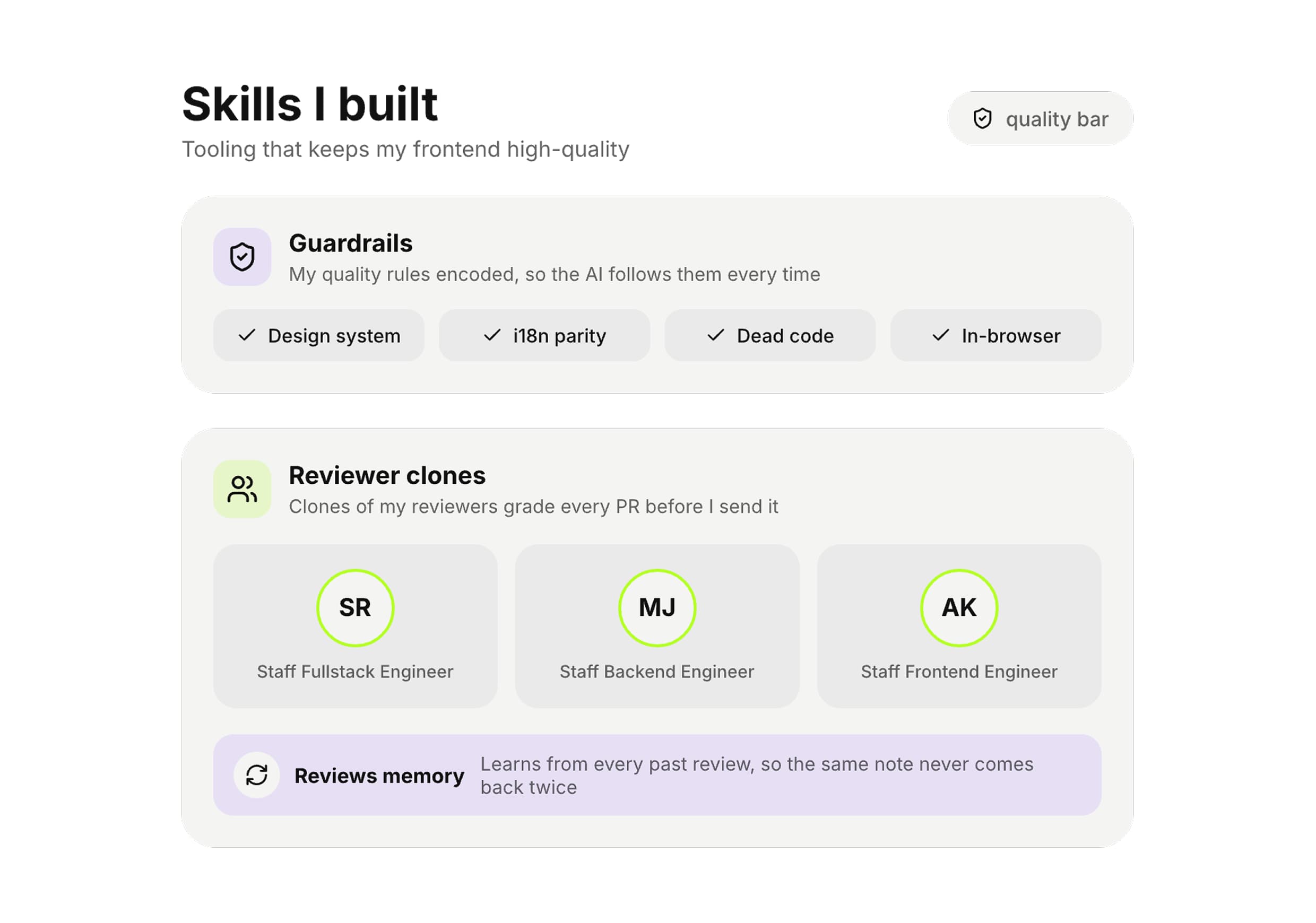
First, guardrails and harnesses: my quality rules encoded so the AI follows them every time. Pre-write audits, design-system reuse, i18n parity, dead-code checks, and in-browser verification before I call anything done.
Then the part I'm most proud of: a compounding quality loop. It reads every code review my senior colleagues leave on my PRs and compiles it into a persistent memory, so the same note never comes back twice. I recently took it a step further. I had Claude study all of my reviewers' past comments and build a clone of each of them, a little panel that reviews my PRs the way they would, before I ever send them out. So every PR I open is already cleaner than the last one.
First, guardrails and harnesses: my quality rules encoded so the AI follows them every time. Pre-write audits, design-system reuse, i18n parity, dead-code checks, and in-browser verification before I call anything done.
Then the part I'm most proud of: a compounding quality loop. It reads every code review my senior colleagues leave on my PRs and compiles it into a persistent memory, so the same note never comes back twice. I recently took it a step further. I had Claude study all of my reviewers' past comments and build a clone of each of them, a little panel that reviews my PRs the way they would, before I ever send them out. So every PR I open is already cleaner than the last one.
What stays human
Where I spend my judgment
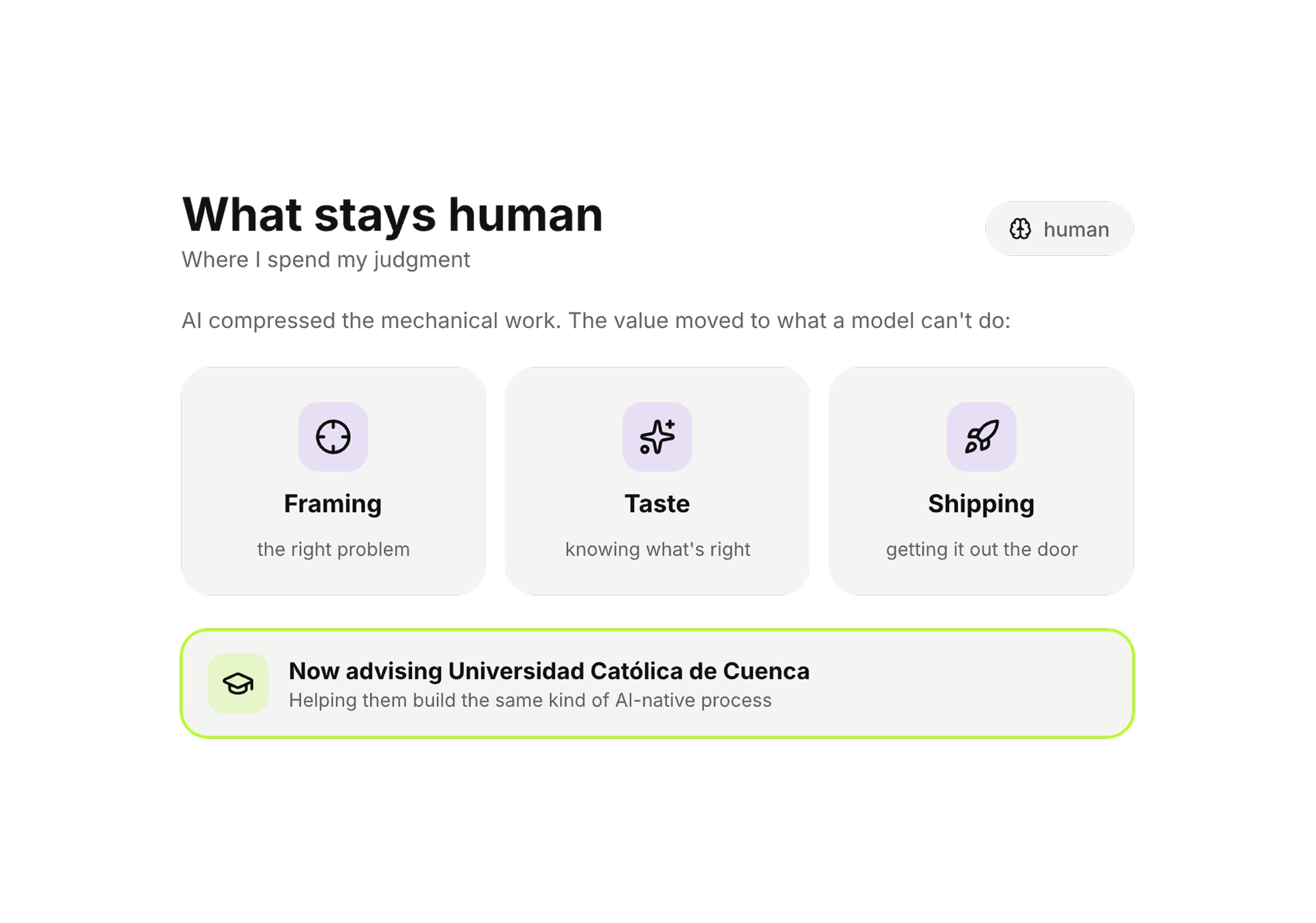
AI compressed the mechanical parts of my work. That just moved the value to the parts a model can't do: framing the right problem, having the taste to know which option is actually right, and doing the work to actually get it shipped. That's where I spend my judgment.
The result is a one-person design practice that moves like a bigger team, and ships real product. It's working well enough that other companies now bring me in to help them build the same kind of AI-native process. Right now I'm advising Universidad Católica de Cuenca on exactly that.
The result is a one-person design practice that moves like a bigger team, and ships real product. It's working well enough that other companies now bring me in to help them build the same kind of AI-native process. Right now I'm advising Universidad Católica de Cuenca on exactly that.